MissionIn my practice I bridge the gap between the past and the present, fostering deep appreciation for the healing power of nature and spiritual connections, while offering compassionate support and guidance to those seeking holistic well-being.
PhilosophyMy approach is rooted in rich traditions of Western astrology and herbalism, while incorporating insights from contemporary scientific research and 21st-century realities.
Certifications
Publications
In addition to my blog and my podcast, I have published in other places as well:
|
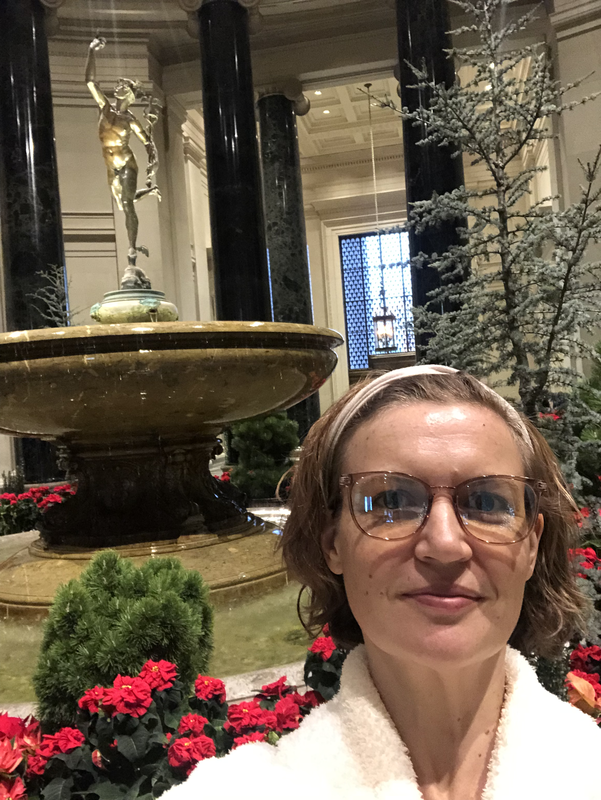
At the U.S. Library of Congress, in front of a statue of Hermes/Mercury, ruler of both astrology and medicine.
|
Ethics
Medical Claims
I am not a licensed medical or mental healthcare provider. It is unethical (and, indeed, illegal in the United States) for anyone without a medical degree to make medical claims, such as the ability to diagnose or treat any disease. I wholeheartedly agree with these laws and injunctions. They are meant to protect people. I will not pretend to be something I'm not. I am here to support, educate, encourage, and empower you in your unique journey of health. I am not here to prescribe, medicate, diagnose, or make claims about any health intervention that crosses the line into medical advice.
Scope of practice
I enthusiastically believe in the power of lifestyle, diet, herbs, spirituality, and other natural health modalities to create positive change in people's lives. However, I also know that natural interventions have their limits, and there is a place for modern medicine as well. I try to be as clear as possible about both the power and the limitations of natural health interventions. I will refer out when something is out of my scope of practice. I enjoy working alongside other practitioners, whether they be medical doctors, mental health therapists, body workers, and other specialized professionals.
Do no harm
I hold the health and safety of my clients in the highest regard, and I recognize the dangers of wading into the waters of the world of health. One reckless word can create anxiety or panic; one misinformed recommendation can lead the client to an intervention that causes physical or psychological damage. This is terrifying and awe-inspiring, and I do not approach this field lightly. If in doubt, I err on the side of caution.
When asking an astrological question, sometimes we receive an answer we do not want to hear. The heavens will be honest with us, and if the situation is bleak the skies will say so. However, I believe the reason the heavens call us to ask a divinatory question in the first place is to invite us to touch a transcendence which sees us and wants our growth and well-being. There is always hope. The hope may be in an area we aren't expecting it, but the hope can always be found. I will never tell you that your life is doomed.
When recommending herbal or lifestyle interventions, I only work with plants that are broadly considered safe for most people. I check with any studies regarding contraindications for medical conditions. If in doubt, I choose something else. The beauty of herbalism is that there is always another herb that can do similar things!
When asking an astrological question, sometimes we receive an answer we do not want to hear. The heavens will be honest with us, and if the situation is bleak the skies will say so. However, I believe the reason the heavens call us to ask a divinatory question in the first place is to invite us to touch a transcendence which sees us and wants our growth and well-being. There is always hope. The hope may be in an area we aren't expecting it, but the hope can always be found. I will never tell you that your life is doomed.
When recommending herbal or lifestyle interventions, I only work with plants that are broadly considered safe for most people. I check with any studies regarding contraindications for medical conditions. If in doubt, I choose something else. The beauty of herbalism is that there is always another herb that can do similar things!
Continuous Professional development
I strive to learn as much as possible about traditional health practices and also stay current with modern research. I love science, and I also love delving into the long lineage of traditional practitioners of the past. Obviously, I am human, and there are gaps in my understanding. But my efforts are always to be as thorough as possible, and as careful as possible.
I attend conferences, courses, or webinars multiple times per year, that push me to grow and learn. Nobody is ever complete in their knowledge!
I attend conferences, courses, or webinars multiple times per year, that push me to grow and learn. Nobody is ever complete in their knowledge!
Client empowerment
YOU are in charge of your own body. YOU know what your own experience is like. YOU know what you can handle and what you can't. While much of life is out of our control, and I won't sugarcoat that fact, I find it an exciting challenge to discover what we CAN control, where the boundaries of possibility lie, and where jewels of joy may be hidden. I will never shame, manipulate, or hassle my clients about any aspect of their health. I gently encourage everyone to find their own way, their own solutions, and their own paths to joy.
I don't approach astrology as a mere technique for getting the "right" answer. While I do use traditional techniques passed down from generation to generation as faithfully as I can, I nonetheless approach the chart with the understanding that my clients are not shallow askers of questions, but complex spiritual and psychological beings. I am always looking for the opportunity for spiritual growth.
I also do not believe in pure determinism. I believe that choices and empowering options are always available. The heavens can tell us the situation we are working with, but they do not box us in to just one mode of action.
I don't approach astrology as a mere technique for getting the "right" answer. While I do use traditional techniques passed down from generation to generation as faithfully as I can, I nonetheless approach the chart with the understanding that my clients are not shallow askers of questions, but complex spiritual and psychological beings. I am always looking for the opportunity for spiritual growth.
I also do not believe in pure determinism. I believe that choices and empowering options are always available. The heavens can tell us the situation we are working with, but they do not box us in to just one mode of action.
Holistic considerations
Just as no symptom is ever isolated from the rest of the body, no person is unaffected by their community and by society at large. I recognize the power that broader social currents and environmental forces have on the physical health of individuals. Healing one person requires addressing the healing of everyone, as well as the healing of the Earth. In practice, this concept could manifest through collaborative approaches to health, community-based programs, policies promoting equity and justice, and movements that aim to address systemic issues.
Additionally, plants are also part of larger ecosystems, which need to be protected and preserved. I do not work with plants that are at-risk. I also do not work with plants that are harvested from exploited peoples.
Additionally, plants are also part of larger ecosystems, which need to be protected and preserved. I do not work with plants that are at-risk. I also do not work with plants that are harvested from exploited peoples.
Astrological Techniques (the nerdy stuff)
For those interested in my astrological techniques!
I follow methods of interpreting astrological charts which have been passed down for centuries. There are too many techniques to list here fully, so I'm just listing the more unusual ones, in case you may have received a reading from a different astrologer who used different techniques.
I hold no judgment on any astrologer who uses other techniques! These are just the ones I've chosen, for reasons I try to explain briefly.
I follow methods of interpreting astrological charts which have been passed down for centuries. There are too many techniques to list here fully, so I'm just listing the more unusual ones, in case you may have received a reading from a different astrologer who used different techniques.
I hold no judgment on any astrologer who uses other techniques! These are just the ones I've chosen, for reasons I try to explain briefly.
Zodiac
I use the Tropical Zodiac, and I practice in a Western context.
Chart Points
I use only bodies that are visible from our planet without telescopes, and points derived from these. Thus, I do not use Uranus, Neptune, Pluto, or asteroids, for example. Ancient techniques work more coherently when using only the bodies that were originally available to the ancients who wrote them down. Additionally, I hold the philosophical opinion that our ancestors were neither better nor worse, spiritually, than we are; they simply lived at a different point in history. Thus I see no need to change our spiritual tools drastically by introducing new symbols, just because technology has changed.
house system
I use the Regiomantanus house system for most of my work. The Regiomantanus system is a quadrant system, which divides the celestial equator.
My primary reason for using Regiomantanus is that it divides the Great Circle that is closest to us on earth (the equator), rather than a Great Circle derived from a farther body. (The ecliptic, for example, is derived from the Earth's relationship with the Sun.) Since my work focuses on physical health and practical issues dealt with in horary questions, I am mostly operating in what the mystics would call the "sublunar realm." It makes philosophical sense to me, to choose a house system that is also sublunar.
Additionally, since the ascendant is calculated using the celestial equator (because we need it to determine what "East" means), it makes sense to me to continue using the celestial equator to create the houses as well.
A great benefit of using a quadrant system is that I like to consider aspects to house cusps in delineating answers. I find the cusps provide nuance and important insights.
(I feel the need to repeat that I do not judge people who use other systems. There are reasons to use other systems, and everyone can pick which systems resonate with them.)
My primary reason for using Regiomantanus is that it divides the Great Circle that is closest to us on earth (the equator), rather than a Great Circle derived from a farther body. (The ecliptic, for example, is derived from the Earth's relationship with the Sun.) Since my work focuses on physical health and practical issues dealt with in horary questions, I am mostly operating in what the mystics would call the "sublunar realm." It makes philosophical sense to me, to choose a house system that is also sublunar.
Additionally, since the ascendant is calculated using the celestial equator (because we need it to determine what "East" means), it makes sense to me to continue using the celestial equator to create the houses as well.
A great benefit of using a quadrant system is that I like to consider aspects to house cusps in delineating answers. I find the cusps provide nuance and important insights.
(I feel the need to repeat that I do not judge people who use other systems. There are reasons to use other systems, and everyone can pick which systems resonate with them.)
cazimi
Some astrologers consider any planet that conjoins the Sun within 1 degree to be in a condition called "Cazimi." However, I only consider a planet to be Cazimi if it is "stealing" some of the light from the Sun: i.e. when it crosses over the face of the Sun. Thus, only planets that can come between Earth and the Sun (Mercury and Venus) can be Cazimi. This can only occur when a planet is retrograde in the interior part of the cycle. Thus, Cazimis are relatively rare. Normally when a planet conjoins the Sun, it is considered to be in a weakened position— crossing through the Underworld, devoid of light, and undergoing purification and tribulation. However, for a very brief period of time, when Mercury or Venus is able to steal some of the Sun's light, the energy is similar to receiving a flash of inspiration, a rush of strength, or a seed of divine revelation, and thus it mitigates the debility of the planet.
I heard this teaching from Linea Van Horn, and it makes much more sense than the broader definition of Cazimi.
I heard this teaching from Linea Van Horn, and it makes much more sense than the broader definition of Cazimi.
saturn!
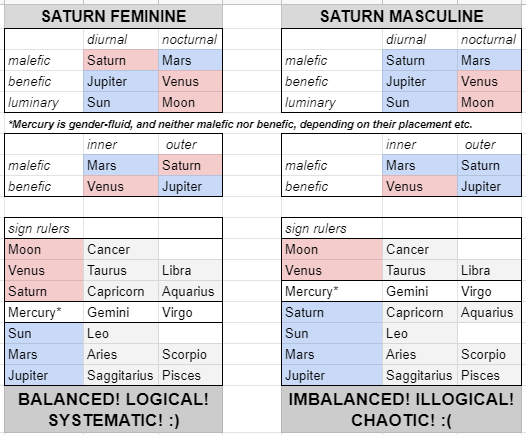
When I need to use genders to describe planets, I make Saturn feminine. Admittedly, this is a deviation from the Tradition as practiced for at least the past millennium. However, I believe the planet we now call Saturn was originally understood as feminine, but this knowledge was either lost or suppressed, over the ages. I recognize that there is only scant evidence for this (Dorotheus, one of the earliest surviving astrological writers, did make Saturn feminine). I am perfectly fine stating this as conjecture rather than being a solid fact. However, there are theoretical reasons for holding this conjecture. Saturn being feminine affords a perfectly balanced esoteric system. (See the tables below.) Saturn being masculine creates a serious imbalance that all the feminine asteroids in the galaxy can't fix (because asteroids do not rule signs). Sometimes I use "it" as the pronoun for the planets, but in some contexts this feels disrespectful, depending on what I'm talking about. So when it comes to Saturn, if I need a gender, I use "she."
However, gender must be understood very loosely in astrology. It's extremely common for a so-called "masculine" planet (e.g, Mars) to symbolize a woman in a chart reading, or for a so-called "feminine" planet (e.g. Venus) to symbolize a man. The heavens are not, apparently, gender essentialists, and neither am I. (Someday I hope to publish an essay on this topic.)
Observe the balance when Saturn is feminine versus masculine, by comparing the highlights in the systems below.
However, gender must be understood very loosely in astrology. It's extremely common for a so-called "masculine" planet (e.g, Mars) to symbolize a woman in a chart reading, or for a so-called "feminine" planet (e.g. Venus) to symbolize a man. The heavens are not, apparently, gender essentialists, and neither am I. (Someday I hope to publish an essay on this topic.)
Observe the balance when Saturn is feminine versus masculine, by comparing the highlights in the systems below.